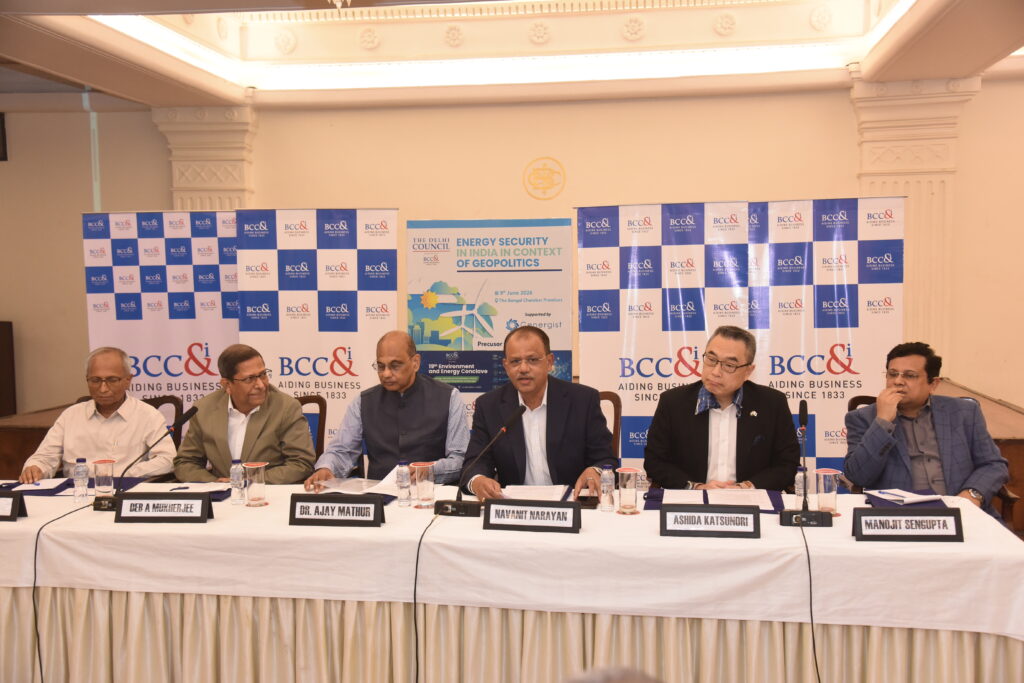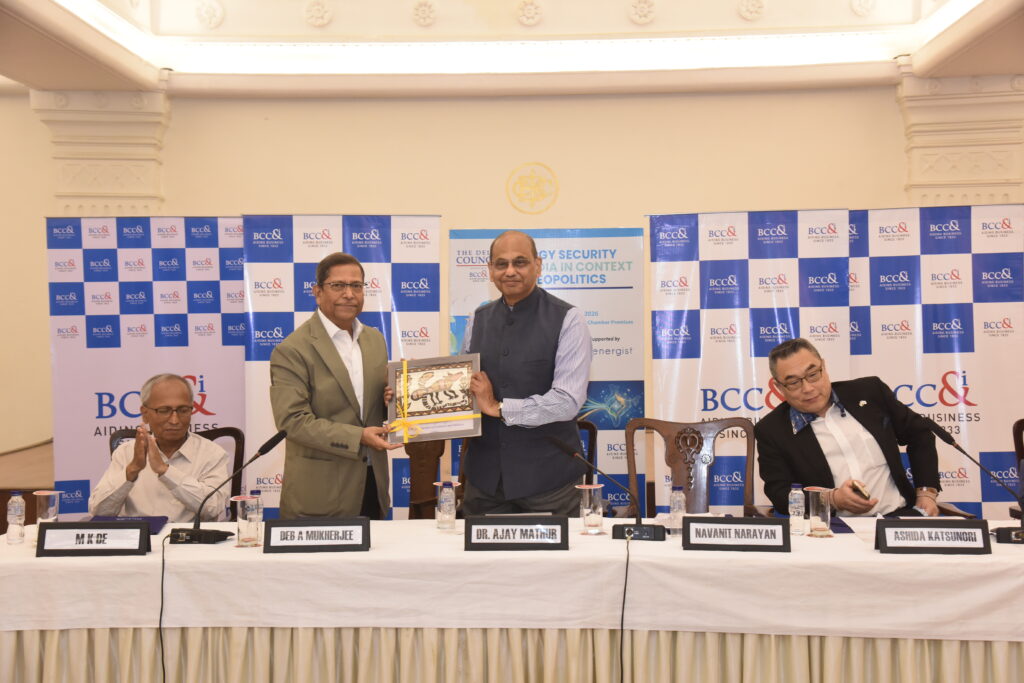
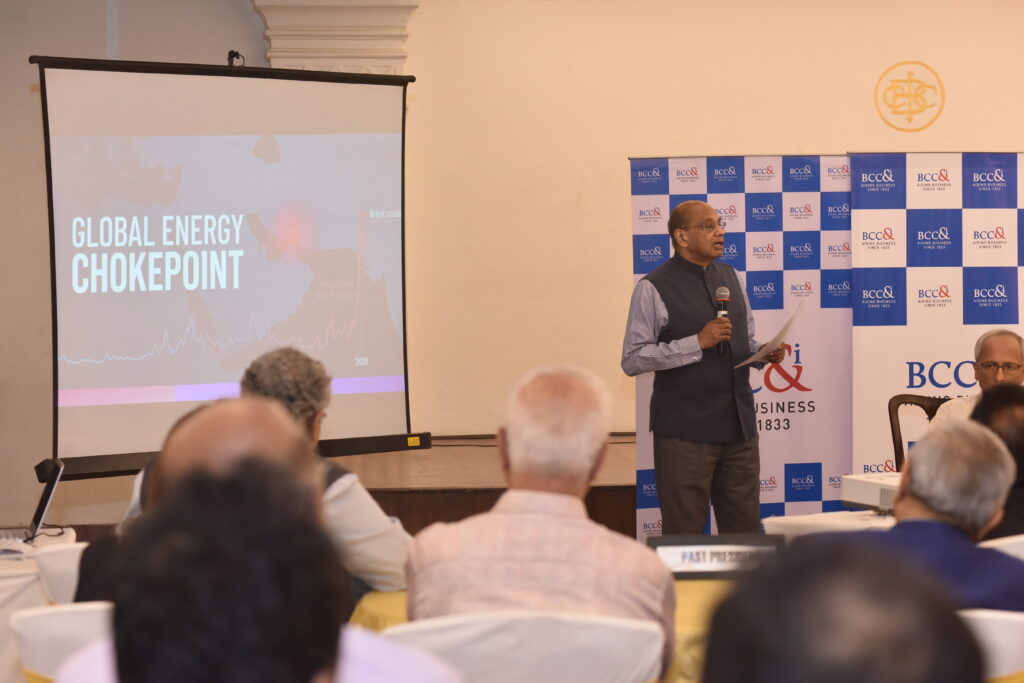
Ajay Mathur
Professor, School of Public Policy, IIT Delhi
Distinguished members of the Bengal Chamber, ladies, and gentlemen.
It is a privilege to stand before one of India’s oldest and most forward-looking mercantile institutions.
Introduction: The Illusion of Cheap Electrons and Open Waters
We are meeting at a moment when the map of global energy is being rewritten in real-time. For decades, industrial strategy was built on a comfortable assumption: that energy security was primarily a function of price. If the market was well-supplied, the molecules would flow.
The events of early 2026 have shattered that illusion. The escalation in West Asia and the resulting blockade of the Strait of Hormuz have reminded us of a harsh reality. One-fifth of the world’s oil and gas supply passes through a single maritime chokepoint. When that chokepoint constricts, Brent crude surges past $115 a barrel within weeks, and spot LNG markets go into paroxysm, the price we pay at the pump or the factory gate isn’t just the cost of extraction—it is a steep, volatile geopolitical risk premium.
For India, this isn’t an academic problem. We import over 80% of our crude oil, and more than half of it traces its lineage back to the Persian Gulf. What we are witnessing today is not just a temporary spike in the commodity cycle; it is a structural validation that our dependency on concentrated fossil fuel corridors is a vulnerability to our national balance sheet and industrial competitiveness.
The Short-Term Crucible
Let us look at the immediate pressure cooker. The 2026 fuel shock has triggered what many are calling a “tactical retreat” across various geographies. We see nations in Southeast Asia and Europe scrambling to stabilize their grids, freezing power tariffs, subsidizing fuel, and even turning back to older, carbon-intensive assets just to keep the lights on.
But a tactical retreat is not a strategy. It is a reflex.
For the corporate leaders sitting in this room, this volatility hits your operating margins instantly. High fuel costs feed into logistics, which in India already consume roughly 13–14% of GDP. It drives up the cost of captive power generation. It creates inflationary pressure that dampens consumer demand.
The Core Realization: We can no longer afford to view energy security and the green transition as two opposing forces. Historically, green initiatives were framed around climate altruism—reducing carbon for the global good. Today, the narrative must flip completely. The primary driver for alternative energy technologies is national and industrial security, not just decarbonization.
Every megawatt of solar power deployed, every kilolitre of green hydrogen synthesized, and every commercial fleet switched to electricity is a step toward insulating your business from decisions made thousands of miles away in maritime chokepoints.
The Strategic Paradigm Shift
How do we build this resilience? The long-term outlook requires us to look at three secular shifts that are defining the remainder of this decade:
- The Electrification Acceleration: Even amid the current crisis, the pace of electrification is structural. Solar PV is leading the charge globally. However, as intermittent renewables scale, the conversation must shift from generation to integration. We need system flexibility—smart grids, pumped hydro, and battery storage.
- The AI and Technology Demand Boom: We are on the cusp of an artificial intelligence revolution. But AI runs on data centers, and data centers run on highly reliable, 24/7 baseload power. Globally, we are seeing a massive surge in power demand driven by advanced computing. If we power the AI revolution with volatile, imported fossil fuels, we are simply trading one security vulnerability for another. We need modular energy systems and localized, high-reliability green power loops.
- The Rise of Alternative Value Chains: As we move toward batteries and electric drivetrains, the geopolitical risk shifts from oil fields to critical mineral mines—lithium, cobalt, and rare earths. True energy security means diversification. It means moving toward mineral-light technologies like sodium-ion batteries and building robust domestic recycling ecosystems so that the circular economy becomes our secondary mine.
The Eastern Gateway and Indo-Japan Synergy
This brings me specifically to the geography of our host today: Kolkata and Eastern India.
The East is undergoing a quiet economic awakening. This region has historically been the mineral and industrial spine of the country, heavy with steel, cement, and manufacturing. These are the “hard-to-abate” sectors where simple electrification isn’t enough. You cannot run a blast furnace on a standard rooftop solar panel.
This requires deep technology deployment: green steel processes, carbon capture and storage (CCS), and localized hydrogen hubs. We must look closely at our strategic international partnerships, particularly with nations that share our exact vulnerability to energy imports. Look at Japan. Japan imports nearly all of its energy, yet it has mastered precision engineering, automation, and hydrogen technologies.
The upcoming bilateral focus on scaling SME partnerships—particularly along the Eastern Corridors—is exactly where the rubber meets the road.
| Strategic Vector | Japanese Vector | Indian Execution | Target Outcome |
| Grid Resilience | Advanced Energy Storage & Solid-State Systems | Scaled Manufacturing & Local Software Integration | Lowering Industrial Curtailment |
| Logistics Efficiency | Precision Supply Chain Automation | Infrastructure Growth along Eastern Corridors | Reducing Logistics Cost toward 8% |
| Alternative Energy | Green Hydrogen & Cellulosic Biofuels | Massive Domestic Scale & Industrial Offtake | Replacing Geopolitically Volatile Gas Imports |
By connecting Japan’s technology with India’s industrial scale, particularly through our nimble Small and Medium Enterprises (SMEs), we can build localized equipment manufacturing supply chains. We don’t just need to import solar panels and batteries; we need to co-innovate and manufacture them right here in the Eastern Gateway.
Conclusion: From Dialogue to Deployment
Ladies and gentlemen, the era of predictable, cheap fossil fuel logistics is drawing to a close. The geopolitical risk premium is here to stay.
The theme that must guide our industries moving forward is simple: From Dialogue to Deployment. We have spent the last decade discussing the possibilities of energy transition. The current geopolitical crucible demands that we execute.
Members of the Bengal Chamber, I leave you with three corporate imperatives:
- De-risk your energy architecture: Treat energy procurement not as a utility bill, but as a core pillar of your geopolitical risk management strategy. Increase your share of captive open-access renewable power.
- Invest in efficiency: The cleanest and most secure megawatt is the one you never use. Partner across sectors to deploy AI-driven energy management systems to squeeze out structural waste from your factories and supply chains.
- Leverage regional corridors: Utilize Kolkata’s position as the gateway to the Northeast and ASEAN to build regional energy value chains, exploring cross-border hydro and grid interconnections that diversify our supply.
The energy crisis of 2026 is a stark warning, but it is also an extraordinary catalyst. It gives us the economic rationale to break free from old dependencies and build a resilient, self-sustaining industrial engine.
- This speech was delivered at the Bengal Chamber of Commerce & Industry on 9th June, 2026